
Escalation of the conflict in West Asia between Israel and Iran has had a direct impact on the energy markets, and more broadly on the financial markets as well as the global economy.

The move is to align affordable housing finance flows to the increase in property costs and inflation, says Raghu Mohan.

Global funds have pulled out Rs 1.54 trillion from domestic stocks in fiscal 2024 - 25 (FY25), the highest-ever outflow recorded so far, according to the data compiled by Business Standard. The last time the global funds exited Indian shores in droves was back in 2022, when they sold a net Rs 1.41 in the backdrop of Covid-19.

The Indian automotive market offers around 1 million units annual volume opportunity at a price above $23,000.

This flight of capital began in early August due to risk-aversion created first by rising geopolitical tensions due to North Korean aggression and second by the US Fed's decision to shrink its balance sheet

'We suggest investors with suitable risk appetite to consider allocating 40-50 per cent in large-caps, 25-30 per cent of funds in quality mid and small-caps and the rest in debt and high yield products.'

Indian markets may see some weakness in stocks post Fed hike.

'The economy is clearly at a very soft spot, and earnings growth is disappointing every day.' 'After three great years, the Indian economy has hit a rough patch.'

Higher valuation creation in companies beyond the top 100 has given the domestic markets a shot at a $4 trillion market capitalisation (mcap) - a club exclusive to three countries currently. On November 23, the mcap of all BSE-listed stocks finished at a new record of Rs 328.33 trillion ($3.94 trillion), despite the benchmark indices ending with losses. The mcap was propelled by gains in the broader market, including small and midcap stocks - a trend dominant this year.

'Like every Budget, this time, too, there is chatter around tinkering with the long-term capital gains tax.' 'Investors may not want to jump into the markets until there is clarity on this front.'

After falling 17 per cent since the start of the year to its March lows, the stock of the country's largest pharmaceutical (pharma) company, Sun Pharmaceutical Industries, has clawed back nearly half of those losses. Recent acquisitions, a favourable court ruling in the case of the hair loss drug Leqselvi, an edge over peers owing to its specialty portfolio, and a diversified global presence have supported the recovery.

Titan Company, Axis Bank, NTPC, Tata Motors, ITC, Tech Mahindra, Bajaj Finserv, ICICI Bank, HDFC Bank and Bajaj Finance were the other laggards. Bharti Airtel, Power Grid, Infosys and Larsen & Toubro were among the gainers.

ICICI Bank was the top laggard in the Sensex pack, cracking over 5 per cent, followed by Kotak Bank, HUL, HDFC, IndusInd Bank, HDFC Bank and Nestle India. On the other hand, Hero MotoCorp, Bajaj Auto, Maruti, TCS and HCL Tech were among the gainers.

From the 30 blue-chip pack, Mahindra & Mahindra, IndusInd Bank, Bajaj Finance, Tata Motors, Bajaj Finserv, Nestle and ICICI Bank were the biggest gainers. State Bank of India, Tata Steel, Adani Ports, Zomato, UltraTech Cement and HCL Tech were among the laggards.

Foreign investors continue to pull back money from the Indian equity market, withdrawing Rs 24,753 crore (about $2.8 billion) in the first week of March amid escalating global trade tensions and lacklustre corporate earnings.

When Gensol Engineering made its public market debut through a small and medium enterprises (SME) initial public offering (IPO) in September 2019, its promoters held a commanding 96 per cent stake. Now, that figure has shrunk to a "negligible" fraction.

From the 30-share blue-chip pack, Larsen & Toubro rallied nearly 5 per cent. Adani Ports, IndusInd Bank, Tata Motors, Reliance Industries, UltraTech Cement and Asian Paints were also among the major gainers. ITC Hotels, Zomato, Nestle and Maruti were among the laggards.

There is little sense in trying to find stocks that will not be vulnerable in a situation where 87% of the market is trending down and India is getting set for a crucial election, says Devangshu Datta.

India's steel market is out of step with global trends. Global demand is weak with China at a huge supply surplus to its domestic demand, pushing down global steel prices. India's domestic demand for steel is strong, given the continuing infrastructure push and is likely to accelerate as urbanisation improves, and the auto sector continues to grow alongside the infrastructure push.

The meltdown in Dalal Street that wiped out investor wealth to the tune of 44 trillion in 2025 also seems to be having a ripple effect on the country's vibrant automobile retail sales.

The trigger for international gold prices rising to $3,000 per ounce was Germany's upcoming heavy government borrowing.

Among the Sensex firms, Infosys, Tech Mahindra, HCL Technologies, Tata Consultancy Services, Wipro and JSW Steel were the major gainers during the morning deals. Nestle, Bharti Airtel, Axis Bank ITC were among the laggards.

The value of foreign portfolio investors' (FPI) holdings in the domestic equities reached $584 billion at the end of December 2022, which was 11 per cent lower from preceding year, according to a Morningstar report. This was largely on low return given by the Indian equities and exodus of foreign money from the domestic stock market. Going by the report, the value of FPIs investments in Indian equities dropped to $584 billion as of December 2022 as compared to $654 billion at the end of December 2021.

These stocks offer the best combination of maximum 'buy' recommendations from brokerages and share price upside over the next 12 months.

After disappointing guidances in the first quarter (Apr-Jun) of the 2023-24 financial year (Q1FY24) and valuation downgrades, the Indian IT sector could see some positive repricing as the bad news for IT maybe easing in Q2FY24. A key negative factor was weaker demand from the US financial sector and from North America in general. The latest GDP (gross domestic product) estimates and sector-specific news suggest that the demand situation may not be quite so bad with a gradual recovery in tech spending in Q2.

India needs another shot of difficult reform, of the kind only possible at gunpoint. Mr Trump holds that gun to our heads now. A drastic reduction in tariff protection, other elements of sarkari wet-nursing will force entrepreneurial India to become competitive again, argues Shekhar Gupta.

Shares of public sector enterprises have corrected by up to 22 per cent month-to-date until March 19, 2024. Analysts attribute this steep fall to the valuation exuberance seen after a sharp run in these counters last year and suggest investors remain selective regarding the stocks in this space. "The rally in public sector undertaking (PSU) stocks has been stretched and sharp, although it is somewhat justified by improvements seen in earnings, operations, balance sheets, and overall profitability.

The Sensex and Nifty ended at fresh lifetime peaks on Tuesday amid a largely firm trend in other Asian markets and continuous foreign fund inflows. The 30-share BSE Sensex gained 177.04 points or 0.28 per cent to settle at 62,681.84, its fresh record closing high. During the day, it jumped 382.6 points or 0.61 per cent to its lifetime intra-day peak of 62,887.40.

Automotive (auto) major Tata Motors posted a 51 per cent drop in consolidated net profit for the January-March quarter (Q4) of 2024-25 (FY25), to Rs 8,470 crore, due to a deferred tax asset of almost Rs 9,000 crore in the corresponding quarter of the previous financial year and an exceptional item of Rs 566 crore during the quarter. Revenue was up just 0.5 per cent year-on-year (Y-o-Y) at Rs 1.18 trillion for Q4FY25.

The Indian equity markets will soon account for over a fifth of a key emerging market (EM) benchmark tracked by funds with assets exceeding $500 billion. This development is expected to funnel as much as $3 billion into the domestic markets. Following the latest review undertaken by global index provider MSCI, India's weighting in the MSCI EM index will surpass 20 per cent for the first time, narrowing its gap with the current top-weighted China to fewer than 400 basis points.

From the Sensex basket, Bajaj Finance, Mahindra & Mahindra, HDFC Bank, JSW Steel, Maruti, Wipro, Bharti Airtel, Bajaj Finserv, ICICI Bank and ITC were the major gainers. Nestle India, HCL Technologies, Larsen & Toubro, Tata Consultancy Services, Tata Motors and Infosys were among the laggards.

Tesla needs to either sell the same models with reduced features to lower the cost for Indian market, or incur losses.

Benchmark BSE Sensex rebounded sharply by 941 points while NSE Nifty closed above the 22,600 level on Monday on the back of buying in banking and infra shares and a global stocks rally. The 30-share BSE Sensex jumped 941.12 points or 1.28 per cent to settle at 74,671.28. During the day, it zoomed 990.99 points or 1.34 per cent to 74,721.15.

All sectoral indices ended lower. BSE Telecommunication tanked 2.18 per cent, metal (1.77 per cent), auto (1.70 per cent), energy (1.64 per cent), oil & gas (1.59 per cent), commodities (1.39 per cent) and financial services (1.37 per cent) were the major laggards.

Among Sensex shares, Hindustan Unilever, Bharti Airtel, Tech Mahindra, Infosys, Mahindra & Mahindra, ICICI Bank, ITC and Asian Paints were the biggest winners. On the other hand, Kotak Mahindra Bank, Reliance Industries, NTPC, UltraTech Cement and Power Grid were among the laggards.

The BSE Midcap and Smallcap indices underperformed the largecaps and ended over 1% lower.

Investors lost Rs 24.69 lakh crore in market valuation in the last four days of severe drubbing in the equity market. Spike in global crude prices, unabated foreign fund outflows, a strong US jobs data diminishing early rate cut expectations, and the rupee logging its steepest single-day fall in nearly two years dampened investors' sentiment.

Investors lost Rs 2 trillion as Sensex crashed on Tuesday.
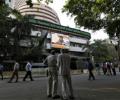
The broader markets also ended lower in line with the benchmark indices
